Showing posts with label WASHINGTON. Show all posts

Wednesday, 12 November 2025

US shutdown fallout: Who came out ahead -- and who didn't


WASHINGTON, Nov 11 (Reuters) - As the U.S. Congress moved toward a deal to end the longest U.S. government shutdown in history, Reuters asked a dozen strategists and analysts to assess who strengthened their position and who paid a price, in the short- and long-term.

DONALD TRUMP: OWNING THE SHUTDOWN
No matter how many times the president has tried to avoid blame for the shutdown, ultimately, the buck stops with him. The White House has faced weeks of headlines about air traffic snarls and low-income families struggling to feed their kids. Even Trump himself admitted that the shutdown probably damaged Republicans in last week’s elections that saw Democrats win in New Jersey, Virginia and New York City.
“Americans recognize that 10 months into his presidency, costs have not gone down. And over the course of this 40-day shutdown, Trump did not emerge as someone who was fighting for them," said Democratic strategist Karen Finney. "He wasn't trying to resolve the issue. He wasn’t engaged, he was nowhere to be found.”
But the public has a short memory. After the government reopens, Trump can train his focus on Americans' cost-of-living concerns before the 2026 congressional midterms. He has shown he can keep his party together under extreme pressure while making few concessions.
“I think he comes out the winner of all this. He had to expend very little political capital in the shutdown," said John Elizandro, a Republican strategist.
"The negotiated deal gives him a resolution without forcing him to further escalate the clash with Senate Republicans over the filibuster,” he added, referring to the Senate requirement of 60 votes to pass legislation.
Consensus: Short-term loss, long-term neutral
SENATE REPUBLICANS: STAYING TOGETHER
Under the leadership of John Thune, Senate Republicans stayed united, held their ground and managed to peel off eight Democrats to vote to reopen the government. Their only concession was agreeing to a December vote on extending healthcare subsidies -- a vote widely expected to fail.
But unity doesn't guarantee immunity.
Recent Reuters/Ipsos polling showed that voters were more likely to blame Republicans than Democrats for the shutdown, a potential warning sign for next year's midterm elections. Some Republicans blamed the shutdown for the trio of losses the party suffered in elections last week.
Consensus: Short-term victory, long-term vulnerability
DEMOCRATS: A SPLIT DECISION
They held their ground – until they didn’t. Many in the Democratic Party are furious that eight senators defected after the party's electoral victories last week. Those senators argued their party's shutdown strategy wasn't working and lasting damage was being done to the economy.
But critics said they left those desperate for relief from healthcare premium increases in the lurch.
“Democrats who supported this compromise are feckless," said Michael Ceraso, a Democratic operative who worked on progressive Senator Bernie Sanders' 2016 presidential campaign. "I believed my party would deliver after (last week's) elections."
If Republicans torpedo the Democratic push to extend healthcare subsidies, it will give Democratic candidates a ready-made issue in the midterms – akin to 2018, when Democrats took back control of the House amid Republican threats to repeal the Affordable Care Act, or Obamacare.
"Democrats have successfully elevated healthcare as a major national issue. This is dangerous for Republicans as healthcare drove the 2018 suburban blue wave," said Carlos Curbelo, a former Republican congressman from Florida.
Consensus: Short-term backlash, long-term leverage
CHUCK SCHUMER: FIRE FROM THE LEFT
The Senate’s top Democrat saw his colleagues do an end-run around him to cut a deal with Republicans.
He voted against the measure, but critics on the left blame him for allowing it to happen, with some progressive advocacy groups and at least one Democratic congressman, Ro Khanna of California, calling for his ouster.
Consensus: Loss
FEDERAL WORKERS: RELIEF, FOR THE MOMENT
Government employees have been big losers in the shutdown, going without pay. Some have taken temporary jobs to help pay bills.
To their relief, the end of the shutdown will restart regular paychecks and give them back pay.
Under the proposed Senate deal backed by Republicans and the small group of Democratic senators, they also get a temporary reprieve from the Trump administration’s layoff push until the end of January.
But these workers must fear another shutdown next year. Both parties have shown their willingness to use federal employees as bargaining chips.
Consensus: Short-term loss, long-term risk
AIRLINE PASSENGERS: STILL BUMPY AHEAD?
The end of the shutdown should allow officials to reverse forced flight reductions at the busiest airports that have caused havoc for hundreds of thousands of travelers.
The government ordered the cuts due to absenteeism among the 13,000 air traffic controllers and 50,000 airport security screeners who have been required to work without pay during the shutdown. Many didn't come to work because they took second jobs or couldn't afford childcare.
On Sunday, the 40th day of the shutdown, 10,200 flights were delayed in the worst day for air travel yet.
If the disruption lingers, it would prolong misery for travelers going into Thanksgiving week, one of the busiest air travel times of the year.
Moreover, even before the shutdown, the U.S. was about 3,500 air traffic controllers short of targeted staffing. Many worked mandatory overtime and six-day weeks, and air travel snarls were common, suggesting disruption may continue.
Consensus: Short-term turbulence, long-term uncertainty
OBAMACARE PARTICIPANTS: PAYING A PRICE?
For Democrats, the shutdown was about protecting consumers from rising health insurance costs as subsidies for Obamacare plans expire at the end of the year.
But the deal to reopen the government didn’t secure those protections — leaving millions who rely on the exchanges exposed to premium hikes.
Democrats hope to pass legislation next month to preserve the subsidies, but the odds are slim. If the effort fails, the families whom they sought to help will feel the full weight of rising premiums with no clear prospects for relief.
Consensus: Short-term loss, long-term threat

Reporting by James Oliphant and Tim Reid; additional reporting by Chris Sanders; Editing by Ross Colvin and Cynthia Osterman

Monday, 10 November 2025

US Senate advances bill to end federal shutdown

WASHINGTON, Nov 9 (Reuters) - The U.S. Senate on Sunday moved forward on a measure aimed at reopening the federal government and ending a now 40-day shutdown that has sidelined federal workers, delayed food aid and snarled air travel.

In a procedural vote, senators advanced a House-passed bill that will be amended to fund the government until January 30 and include a package of three full-year appropriations bills.
If the Senate eventually passes the amended measure, it still must be approved by the House of Representatives and sent to President Donald Trump for his signature, a process that could take several days.
Under a deal struck with a handful of Democrats who rebuffed their party’s leadership, Republicans agreed to a vote in December on extending subsidies under the Affordable Care Act. The subsidies, which help lower-income Americans pay for private health insurance and are due to expire at the end of the year, have been a Democratic priority during the funding battle.
The vote to advance the bill passed by a 60-40 margin, the minimum needed to overcome a Senate filibuster.
“It looks like we’re getting very close to the shutdown ending,” Trump told reporters at the White House prior to the vote.
The bill would prohibit federal agencies from firing employees until January 30, a win for federal worker unions and their allies. It would stall Trump’s campaign to downsize the federal workforce.
Some 2.2 million civilians worked for the federal government at the start of Trump’s second term, according to federal records. At least 300,000 employees are expected to leave the government by the end of this year due to Trump’s downsizing effort.
It would also provide back pay for all federal employees, including members of the military, Border Patrol agents, and air-traffic controllers.
When the Senate reconvenes on Monday, Republican leaders will try to get a bipartisan agreement to circumvent Senate rules and move quickly to passage. Otherwise, the chamber would require much of the coming week to move through procedural actions before voting on final passage, possibly extending the shutdown into next weekend.
“It was a good vote tonight," Senate Majority Leader John Thune told reporters after the Senate adjourned on Sunday. "Hopefully, we'll get an opportunity tomorrow to set up the next votes. Of course, that's going to take some cooperation and consent."
Sunday's deal was brokered by Democratic Senators Maggie Hassan and Jeanne Shaheen, both from New Hampshire, and Senator Angus King, an independent from Maine, said a person familiar with the talks.
Item 1 of 8 An airport staff member helps a traveler at Ronald Reagan Washington National Airport, more than a month into the ongoing U.S. government shutdown, in Arlington, Virginia, U.S., November 9, 2025. REUTERS/An, opens new tab
"For over a month, I’ve made clear that my priorities are to both reopen government and extend the ACA enhanced premium tax credits. This is our best path toward accomplishing both of these goals," Shaheen posted on X.
Senate Minority Leader Chuck Schumer, the chamber's top Democrat, voted against the measure.
Many Democrats on the Hill watched the deal unfold with displeasure.
“Senator Schumer is no longer effective and should be replaced,” wrote U.S. Representative Ro Khanna on X. “If you can’t lead the fight to stop healthcare premiums from skyrocketing for Americans, what will you fight for?"
Sunday marked the 40th day of the shutdown, which has sidelined federal workers and affected food aid, parks and travel, while air traffic control staffing shortages, opens new tab threaten to derail travel during the busy Thanksgiving holiday season late this month.
Senator Thom Tillis, a Republican from North Carolina, said the mounting effects of the shutdown pushed the chamber toward an agreement.
"Temperatures cool, the atmospheric pressure increases outside and all of a sudden it looks like things will come together," Tillis told reporters.
Should the government remain closed for much longer, economic growth could turn negative in the fourth quarter, especially if air travel does not return to normal levels by Thanksgiving, White House economic adviser Kevin Hassett warned on the CBS "Face the Nation" show. Thanksgiving falls on November 27 this year.
The wrangling on Capitol Hill came as Trump on Sunday again pushed to replace subsidies for the Affordable Care Act's health insurance marketplaces with direct payments to individuals.
The subsidies, which helped double ACA enrollment to 24 million since they were put in place in 2021, are at the heart of the shutdown. Republicans have maintained they are open to addressing the issue only after government funding is restored.
Trump took to his Truth Social platform on Sunday to blast the subsidies as a "windfall for Health Insurance Companies, and a DISASTER for the American people," while demanding the funds be sent directly to individuals to buy coverage on their own. "I stand ready to work with both Parties to solve this problem once the Government is open," Trump wrote.
Americans shopping for 2026 Obamacare health insurance plans are facing a more than doubling of monthly premiums on average, health experts estimate, with the pandemic-era subsidies due to expire at the end of the year. The ACA enrollment period, however, runs through January 15, which would allow time for a legislative effort to extend the credits for next year.

Reporting by David Morgan in Washington, Nathan Layne in Wilton, Connecticut, Matt Tracy in Washington, and David Ljunggren in Ottawa; Writing by James Oliphant; Editing by Sergio Non, Chris Reese, Edmund Klamann, Stephen Coates and Kim Coghill

Friday, 7 November 2025

U.S. airlines scrambled cut 4% of flights

WASHINGTON, Nov 7 (Reuters) - U.S. airlines on Friday scrambled to cut 4% of flights at 40 major airports after the government imposed an unprecedented cut to air travel citing air traffic control safety concerns because of a record-setting government shutdown.
The cuts, which began at 6 a.m. ET (1100 GMT), include about 700 flights from the four largest carriers - American Airlines, Delta Air Lines, Southwest Airlines and United Airlines - and are set to rise to 6% on Tuesday and then 10% by November 14 if the shutdown does not end.
The cuts don't apply to international flights.

MORE CUTS WOULD BE 'PROBLEMATIC', AMERICAN AIRLINES SAYS

American Airlines CEO Robert Isom does not expect significant disruption for customers from initial government-ordered flight reductions, he said on Friday, warning that increased cuts would be "problematic."
"This level of cancellation is going to grow over time and that's something that is going to be problematic," Isom told CNBC.
Cuts are expected to be less Saturday since airlines generally fly fewer flights on Saturdays.
An airliner makes it's approach into Washington during the government shutdown
An airliner, making it's approach, flies past flags at the base of the Washington Monument, as flight delays surge from the government shutdown which entered its 30th day, in Washington, D.C., U.S., October 30, 2025. REUTERS/Kevin Lamarque Purchase Licensing Rights, opens new tab
United Airlines (UAL.O), opens new tab said half of its impacted customers were able to be rebooked within four hours of their original departure time.
The Federal Aviation Administration did not publish the list of airports impacted until 7:30 p.m. ET Thursday - less than 12 hours before the cuts took effect - and largely rejected concerns airlines raised after they received a draft order.
Airlines were also dealing with the fallout from continuing air traffic controller absences as the FAA slows flights to address staffing issues. Earlier this week, FAA Administrator Bryan Bedford said 20-40% of controllers were not showing up for work on any given day.
During the record long 38-day government shutdown, 13,000 air traffic controllers and 50,000 security screeners have been forced to work without pay.
The FAA on Friday imposed ground delay programs slowing flights at Austin and Reagan Washington National due to staff shortages.
The FAA is restricting space launches as well.
It also warned it could reject specific cuts if they disproportionately impacted certain communities and could cut up to 10% of general aviation flights at high-traffic airports if staffing issues arose.

Reporting by David Shepardson. Editing by David Goodman and Mark Potter

Monday, 14 April 2025

'Worried about something worse than a recession'Ray Dalio,

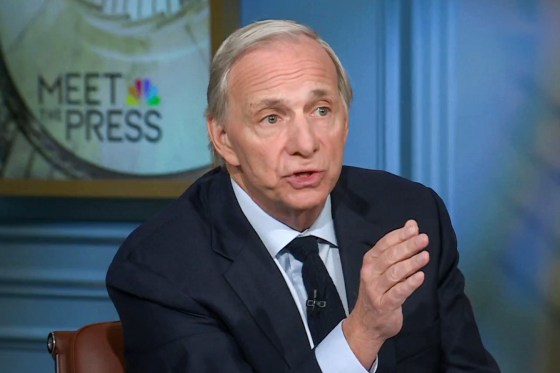
 Ray Dalio speaks

"I've studied history, and this repeats over and over again," Ray Dalio warned Sunday on NBC News' "Meet the Press."NBC NewsRay Dalio, the founder of the hedge fund Bridgewater Associates, warned in an interview on NBC News' "Meet the Press" about tariffs, growing debt and other economic and political concerns.

WASHINGTON — Ray Dalio, the founder of the hedge fund Bridgewater Associates, said Sunday he is "worried about something worse than a recession" if President Donald Trump does not properly handle tariffs and other economic policies.

"I think that right now we are at a decision-making point and very close to a recession," Dalio said on NBC News' "Meet the Press." "And I'm worried about something worse than a recession if this isn't handled well."

Dalio was responding to a question from moderator Kristen Welker about whether the United States would be likely to dip into a recession because of Trump's tariff policies.

Dalio warned that "we have a breaking down of the monetary order," an issue he has spoken about at length on social media.

"We are having profound changes in our domestic order ... and we're having profound changes in the world order. Such times are very much like the 1930s," Dalio said. "I've studied history, and this repeats over and over again."

Dalio referred to the combination of tariffs, excessive debt and a "rising power challenging the existing power" as changes that are "very, very disruptive."

"How that's handled could produce something that is much worse than a recession," he said.

Specifically, Dalio has warned recently about what he said was the unsustainable growth of U.S. debt and creditors, such as China, holding too much of it, as well as the decline in U.S. manufacturing, leading to a reliance on other countries for necessary items.

Dalio said Sunday the situation could "be managed very well," urging members of Congress to pledge to reduce the budget deficit by a few percentage points to 3% of the gross domestic product, a measure of the country's economic activity.

"If they don't, we're going to have a supply-demand problem for debt at the same time as we have these other problems, and the results of that will be worse than a normal recession," he said.

Asked to detail his fears about a worst-case scenario, Dalio said he was worried about "the value of money, internal conflict that is not the normal democracy as we know it, an international conflict in a way that is highly disruptive to the world economy and could even be a military conflict."

Dalio anticipated the 2008 financial crisis. Bridgewater warned in 2007 that "imbedded risks in the system are quite large" ahead of the eventual financial crisis. A few months later, it said it believed interest rates would rise "until there is a cracking of the financial system," adding that "no one knows how this financial market contagion will play out." Months later, the recession began.

Dalio said in a long post on last week ahead of Trump's temporary reductions in his sweeping tariff increases that while the duties were "very important developments," people are "mostly overlooking the vastly more important forces that are driving just about everything, including the tariffs."

"The far bigger, far more important thing to keep in mind is that we are seeing a classic breakdown of the major monetary, political, and geopolitical orders," he wrote. "This sort of breakdown occurs only about once in a lifetime, but they have happened many times in history when similar unsustainable conditions were in place."

AD BANNAR