Monday, 17 March 2025

The Trump White House Is Playing a Dangerous Game With the Courts


 The Trump administration has stepped right up to the line of intentional defiance of a judicial order, perhaps even over it.

We should know in the hours and days ahead whether we have arrived at a legitimate constitutional crossroads — that’ll depend on the details — or whether the administration has adopted a posture of semi-intentional, self-serving recklessness toward the courts. Either way, we’ve got a problem.

On Saturday, federal immigration authorities arrested over 200 alleged members of the Venezuelan gang Tren de Aragua (TdA), based on a 1798 law called the Alien Enemies Act. That law gives the president broad authority to deport noncitizens under two circumstances. First, the law applies when there is a declared war between the United States and a foreign country (obviously inapplicable here). Second, the Act allows deportation in the case of an “invasion or predatory incursion” into the United States by “any foreign nation or government.”

Two issues jump off the page. First, can the presence of TdA be reasonably considered an “invasion or predatory incursion” on American soil? Trump formally proclaimed that the gang has “unlawfully infiltrated the United States” and is “conducting irregular warfare and undertaking hostile actions against the United States.” It’s a stretch, and I suspect most judges would reject the creative pigeonholing effort, but it’s not a facially outrageous legal claim.

Second, even if TdA’s criminal activity can be taken as an “invasion,” that conduct must be attributed to a foreign government. To that end, the Trump administration asserts that TdA “is closely aligned with, and indeed has infiltrated, the Maduro regime, including its military and law enforcement apparatus.” In other words, the argument goes, even if TdA is not the actual Venezuelan government, they’re essentially embedded with the people who run it. Again, feels like a long shot, but not quite ridiculous.

Ordinarily, we’d be gearing up for a high-stakes series of weighty legal arguments about what exactly the act means and whether it applies to the facts here — standard courtroom stuff. Indeed, the Trump administration has appealed the ruling by federal District Court Judge James Boasberg temporarily blocking and halting implementation of any deportation effort, pending resolution of the legal issues: “Any plane containing these folks that is going to take off or is in the air needs to be returned to the United States however that is accomplished,” the judge said from the bench, apparently sensing that the Trump administration might be seeking an end run. “Make sure it’s complied with immediately.”

But, it turns out, the deportees are gone, already flown out of the United States and deposited in prison in El Salvador. Here’s the pivotal question: Where exactly were the deportees at the moment of the judge’s order?

The Washington Post has constructed the most complete timeline available so far. It shows that, at the moment the judge gave his order orally from the bench (6:47 p.m. on Saturday), two of three flights were already in the air, and the third was on the ground. When the judge’s written order hit the docket at 7:26 p.m., the status of all three flights was the same as before: two in the air and one on the ground, though that third flight left ten minutes later at 7:36.

On its face, then, we have two questions. First, why didn’t the Trump administration order the two flights that were already in the air to turn around? They certainly could have done this; we have sophisticated communications technology, and planes can be re-routed. There’s a separate question about whether the judge’s order was binding on a planeload of passengers if it had left the United States and was in non-territorial air. That’s a murky legal question, and could give the Trump administration at least a fig leaf to claim they didn’t openly defy a valid court order. It’s thin, indeed.

The Trump administration also has implied limply that the court order somehow wasn’t official until a written order landed on the docket, 39 minutes after the judge’s in-court statement. That’s a bogus argument, as anyone knows who has ever appeared before a federal judge. When the judge says it from the bench, that’s that.

But the third plane is a problem either way because, according to the Post’s analysis, it took off ten minutes after the judge’s decision was posted on the docket (and 49 minutes after the in-court ruling). Sure looks like open defiance. If and when the judge demands an accounting from the administration, watch for a claim that the lawyers could not practically have communicated the court order exactly contemporaneously with its entry. While it’s fair to allow a few minutes for transmittal of the court’s findings to the appropriate arms of government, 49 minutes is certainly pushing it. Cell phones exist, after all; it’s not like an order would need to be communicated by a courier on horseback.

We also must call out an alternative (and recurring) Trump administration defense: The judge’s decision was a “baseless legal ruling no matter when the flights took off” and therefore the administration was free to ignore it. This rationale is dangerously circular: We think the judge is wrong so we can do whatever we want. The way we decide who is right and wrong is through the courts (including the appeals process) and not by unilateral fiat.

It’s a lose-lose situation for the nation. In one scenario, we have open, intentional defiance by the executive branch of a court order. I’m typically among the last to claim some situation or other is a “constitutional crisis.” Too often, that phrase is deployed as a jacked-up substitute for “something is happening that I don’t like.” In my view, we reach a constitutional crisis only when we don’t know what to do next. And if the president is blowing off the courts, then our only options are pale ones indeed. A judge can make contempt findings, but why would an administration that already defies court orders care about that? If you could ask the Founders what happens to a president who defied the courts, I suspect they’d point to impeachment as the proper constitutional remedy. But we live in modern reality, and that’s not happening.

Even if the Trump administration has not intentionally defied a court order, they’re getting perilously close to the line and they’re reveling in their adjacency to lawlessness. The administration easily could have played it straight, if they cared to do so. Usually litigants in federal courts — particularly the U.S. government — give leeway to a judge’s decision, or even an impending ruling. A good-faith player would have reasoned, “Okay, we have a court hearing coming up on this issue, so let’s wait and see what the judge rules and then act accordingly.” Instead, the administration had those planes loaded, fueled up, and either waiting on the runway or already airborne by the time the judge ruled, with no intention to wait on official word from the court. The defiance in this scenario isn’t quite intentional; it’s more like intentionally reckless. It’s like if I ran through a house blindfolded and holding a burning torch; I might not intend to set anything on fire, but I sure would know that it’s virtually certain to happen.

The Trump administration is right at the brink of intentional defiance here; the forthcoming details will tell us whether they’ve crossed over into willful lawlessness or merely inexcusable recklessness. And this entire scenario is self-imposed. The administration is free to pursue its immigration agenda aggressively and expeditiously, even if that involves pushing the outer boundaries of the law. Instead, they’ve chosen at best to play fast and loose and at worse to throw our legal and political system into havoc.

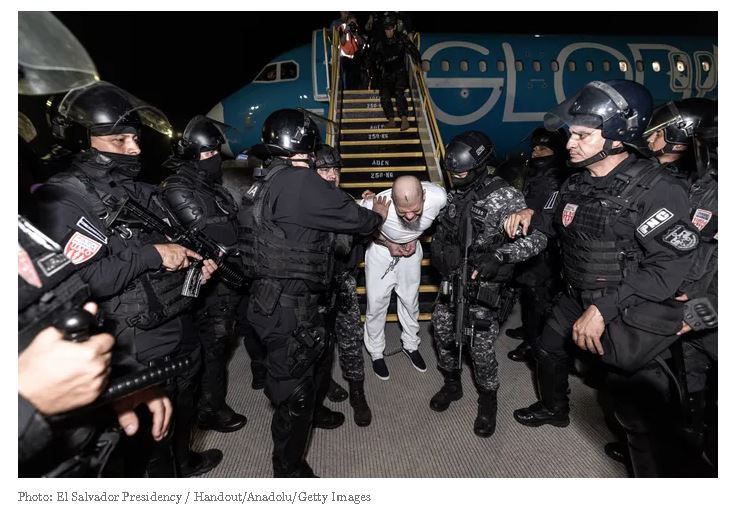
Trump deports 238 ‘gang members’ to El Salvador: What’s the controversy?

Salvadoran police officers cut the hair of alleged members of the Venezuelan gang Tren de Aragua recently deported by the US
Salvadoran police officers cut the hair of alleged members of the Venezuelan gang Tren de Aragua deported by the US [Handout/Press Secretary of the Presidency via Reuters]


Salvadoran police officers cut the hair of alleged members of the Venezuelan gang Tren de Aragua recently deported by the US
President Donald Trump’s administration has deported alleged members of the Venezuelan gang Tren de Aragua from the United States to El Salvador despite a court order prohibiting their expulsion from the country.Sunday’s move is the latest in a series of steps by the Trump administration to expel foreign nationals – some accused of being in the US without documentation, others targeted over campus protests.

What happened?

El Salvador President Nayib Bukele said on Sunday that his country had received 238 Tren de Aragua members and an additional 23 members of the Salvadoran gang MS-13 from the US.Bukele had agreed to jail members of these groups on behalf of the US in a meeting with Secretary of State Marco Rubio last month.

He said these deportees were in the custody of the Central American country’s Centre for the Confinement of Terrorism (CECOT) for a one-year period that could be extended.During Trump’s inauguration speech, he said he would invoke the 1798 Alien Enemies Act. On Saturday, Trump signed a proclamation invoking that 227-year-old law. The proclamation claims that Tren de Aragua is “perpetrating, attempting, and threatening an invasion or predatory incursion” against US territory. It adds that all Venezuelan citizens aged 14 or older “who are members of” the gang and are not naturalised or lawful permanent US citizens are liable to be restrained and removed as “Alien Enemies”.

After Trump’s order, federal Judge James Boasberg, the chief judge of the District Court for the District of Columbia, issued a temporary restraining order to block Trump’s ability to exercise wartime powers to carry out deportations. This was during a hearing on Saturday sought by the American Civil Liberties Union.But hours later, Bukele confirmed that the Trump administration had nevertheless gone ahead with the deportations. He shared a snippet of a news article about the judge’s ruling, captioning it: “Oopsie … Too late” with a crying-with-laughter emoji.

What is the Alien Enemies Act, and how does it work?

The Alien Enemies Act allows US presidents to detain or deport noncitizens during wartime. In 1798, the US was preparing for what it believed was a war with France. The law was introduced to prevent immigrants from sympathising with the French.

The law allows the president to carry out these deportations without a hearing and based only on citizenship.The act has been invoked only three times before, during the War of 1812, World War I and World War II.

Why is this controversial?

While Trump and his allies have argued that the US is at threat of “invasion” by undocumented immigrants, critics said the president is wrongly invoking the wartime law.

An explainer published by the Brennan Center for Justice last year said invoking the act “in peacetime to bypass conventional immigration law would be a staggering abuse”.“The courts should strike down any attempted peacetime use of the Alien Enemies Act,” it added.

The Fifth Amendment of the US Constitution protects the right to a grand jury. “No person shall be held to answer for a capital, or otherwise infamous crime, unless on a presentment or indictment of a grand jury,” it states, adding that wartime is one of the few exceptions to this.

The fact that the Trump administration possibly defied a judge’s order further exacerbates this controversy.The White House’s action was in “open defiance” of Boasberg’s order, Patrick Eddington, a homeland security and civil liberties legal expert at the Washington, DC-based Cato Institute, told the Reuters news agency.

“This is beyond the pale and certainly unprecedented,” Eddington said.But White House Press Secretary Karoline Leavitt has pushed back against the criticism.

“A single judge in a single city cannot direct the movements of an aircraft … full of foreign alien terrorists who were physically expelled from US soil,” Leavitt said in a statement posted on her X account on Sunday. She added: “Federal courts generally have no jurisdiction over the President’s conduct of foreign affairs.”

Bruce Fein, an American lawyer specialising in constitutional and international law, disagreed.“The president is not a king. January 20, 2025, was not a coronation,” Fein told Al Jazeera, referring to the day Trump was inaugurated. “The president is not Napoleon. … Federal courts have jurisdiction over the president. The probability that Trump flouted Judge James Boasberg’s order is high, but we need to await more due process.”

Leavitt argued that by the time the court order was issued, the deportees had been removed from the US. The exact timings of the deportation flight are unclear.

Steve Vladeck, a professor at Georgetown University’s Law Center, posted on Bluesky that “a federal court’s jurisdiction does *not* stop at the water’s edge.” In other words, according to Vladeck, those deportees ought to be brought back to the US even if they had left the US airspace by the time the judge issued his order.

“The court’s jurisdiction turns on the presence of the defendant in the United States, not the plaintiffs,” Fein explained, adding that Trump, the defendant in this case, is in the US. “He could be ordered to return deportees who had been illegally deported to the United States.”

Why were these people sent to El Salvador?

Bukele is detaining the deportees under a deal in which the US agreed to compensate El Salvador to hold them, Bukele wrote in an X post. The Trump administration will pay about $6m to El Salvador for detaining about 300 alleged Tren de Aragua members from Venezuela for a year.

The Salvadorian president also shared a video on his X account showing handcuffed deportees being dragged and having their heads and faces shaved by masked El Salvador police officers.

“The United States will pay a very low fee for them, but a high one for us.”

Mbappe is showing Real Madrid big dreams

It was late November last year. Kylian Mbappe was in a dismal state after losing his rhythm. In the meantime, a picture of Mbappe went viral after the Champions League defeat to Liverpool. In that picture, the French star can be seen upside down with his legs raised up, resting on his neck. 


Many people laughed at the picture at the time. Some even read the picture in conjunction with Mbappe's ongoing plight.Of course, there was little room for critics or trolls to blame. At that time, Mbappe was consistently performing poorly. Which had really cornered him.That bad experience against Liverpool came back in a different way a few days later. On the night of Real Madrid's 2-1 defeat against Athletic Bilbao, Mbappe missed a penalty. After that, some started calling him 'missed penalty'. 

It was quite an embarrassing experience. But the picture was not supposed to be like that at all.After years of drama and ups and downs, Mbappe left PSG for Real Madrid in the summer transfer window. Due to the frequency of events and his name, Mbappe was naturally under the microscope from the beginning. His every moment was being monitored closely. Spectators, supporters, former footballers or the media - everyone had their eyes on him. And Rob was left speechless. Social media was also flooded with comments like 'Real Madrid made a mistake in buying him' or 'Mbappe can't take the pressure'. He had to bear most of the responsibility for the team's poor performance, which was unfair. Everyone seemed reluctant to even give him time to adapt to the team.

In such a situation, Mbappe had to answer on the field. It was not that he was performing very badly from the beginning or that he could not be found on the field. The problem was in consistency. He was not able to play in the same rhythm regularly. In addition, it was not clear what Mbappe's role would be in the team's coordination. For these reasons, he could not even find himself properly. Some were also suspecting that Real Madrid was in such a state because of the abundance of stars. Especially since the past experience with the Galacticos was not good, this fear was not completely unfounded.

But against all the negative talk, Mbappe made a promise. After missing a penalty against Bilbao, he said, "It's a difficult moment. But this is also the best time to change this situation and show who I am." Mbappe did not take long to prove that this was not just talk. The World Cup-winning star quickly turned around and started performing consistently. Which changed the scene at the end of the season. At the moment, if you name one of the most successful stars of the current season, Mbappe's name will definitely come on that list. His return to rhythm is also a great relief for Real Madrid. He has shown Real the way from the front several times at important moments.

Let's take the play-offs to reach the last 16 in the Champions League. After scoring 1 goal in the first leg against Manchester City, he scored a hat-trick in the second leg. It can be said that Guardiola's City surrendered to Mbappe. Then, Mbappe played great in the last 16 against Atletico Madrid. He converted Vinicius Junior's missed penalty in the second leg. If he could have finished that attack without being fouled, it could have been recognized as one of the best goals of the season. Mbappe, who was on loan in the Champions League, has also been brought to La Liga. He scored a brace in Real's 2-1 win over Villarreal on Saturday night. Mbappe is now the second highest scorer in La Liga this season. Mbappe has now scored 20 goals in 26 matches, along with 3 assists. However, another thing is noteworthy here, Mbappe scored 7 goals in the first 14 matches for Real, and 13 goals in the next 14 matches. These statistics seem to be enough to understand the evolution of Mbappe's performance.


Mbappe also set a milestone on the way to this goal. He has the second highest number of goals in his first 25 matches for Real after Cristiano Ronaldo - 18. Ronaldo scored 20 goals in the first 25 matches. Mbappe is now threatening Robert Lewandowski with the highest number of goals in La Liga. Lewa is at the top with 1 goal more than him in 25 matches. And in total, Mbappe's goals in the current season are now 30 in 43 matches, including 4 assists. Now, if we consider the statistics up to this point, Mbappe must be given full marks. If we add to this the performance of shining in big matches or the team's important moments, he is definitely one of the best stars of this season. But Mbappe has done that difficult task very easily. Even the rough form of Mbappe that was heard at PSG was not seen here. Rather, his interaction with Vinicius-Bellingham is quite noticeable. As a result, Real's attack is now sharp and intense.

Despite such performances, Mbappe has not been successful so far. The measure of Real's success is the trophy. As long as the trophy is not in hand, there is no chance to call it successful.

Hopefully, Real has a chance to win three titles at the end of the season. Where, along with the Champions League and La Liga, there is also a chance to win the Copa del Rey. And Real wants Mbappe 100% to use this opportunity. Now it remains to be seen whether Mbappe can maintain the rhythm until the end of the season and bring Real the title.

It was not easy to single-handedly pull all the spotlight from Real's star-studded team in the first season. It is quite difficult to become a solo performer behind a team that has three stars like Vinicius Junior, Jude Bellingham and Rodrygo in the front line.

AD BANNAR